Wednesday, June 1, 2011

Role of Violence: Specific look in Eastern European Revolutions of 1989


http://www.revleft.com/vb/picture.php?albumid=240&pictureid=2916

Why were some revolutions in Eastern Europe non-violent and others violent? Around the year 1989, Eastern Europe was being reshaped by numerous revolutions throughout the continent. Majority of these revolutions were nonviolent, yet Romania and Yugoslavia did have violent revolutions. What made them different?

In Yugoslavia, there were many nationalities fighting over one piece of territory. The result was more of a genocide than a revolution.

In Romania, the leader was a heartless man named Ceausescu. His people were violently forced into submission. The violence did not occur in other countries because the communist leaders themselves did not pose such strong physical opposition to the protests. In Poland, there was a sweeping movement, Solidarity that quickly grew in popularity and power. Despite being made illegal, the movement did not die down and overtook the government by winning the seats in the parliament. In Hungary, the leader was already a reformist and was overthrown and replaced by an election. In Czechoslovakia, there was the Velvet Revolution, a peaceful ten-day protest. Why were all these countries so nonviolent? Clearly their leaders were not as iron fisted as Ceausescu in Romania. They were also too confident in their support, and the downfall of communism was a realization of the fact.

In the Egypt Revolution, Mubarak lost the support of the army. With the loss of the army, he lost control over Egypt. In Libya, Gaddafi had control over the army because they were hired by him and would loss their job if they did not do as he wished. The result was that Egypt's Revolution was much less violent than the Libya's Revolution. These further exemplify how the stance of the country's army affect the overall violence of the revolution.

Friday, May 13, 2011

Khomeini versus Gandhi


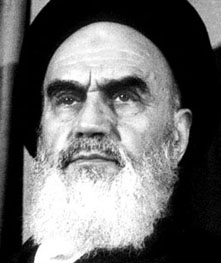
Two of the most earthshaking leaders, Khomeini and Gandhi, had diametrically opposed views on revolution. While Khomeini was all about war, Gandhi was all about non-violence. While Khomeini was supporting the US Embassy hostage crisis, Gandhi led the Salt March. Khomeini was all about one religion, Islam, while Gandhi was advocating for peace and unity between the hindus and the muslims in India. How can two such different people both be the faces of revolution? Is it the country that makes the difference between violence and nonviolence, Khomeini and Gandhi? Religion played a large role in the Iranian Revolution, part by Islam being such a large part of the people's lives and part by the emphasis Khomeini put on religion. They began their revolution like a jihad, or holy struggle (yet commonly associated with violence). In India, human rights and equality were the motivating factors, and the means to achieve them was through satyagraha. Would satyagraha have worked in Iran? It is not likely that a peaceful uprising would be developed in a country already ruled by terror. Could a Khomeini-like figure have succeeded in India? Violence seems to be the human instinct during a revolution and there was undoubtably violent acts during the Indian Revolution. It is more common for a revolution to be led by a "Khomeini" than by a "Gandhi."


http://www.nndb.com/people/915/000031822/khomeini2-sized.jpg
http://www.norcalblogs.com/post_scripts/gandhi.jpg

Wednesday, May 11, 2011

Khomeini versus Gandhi


http://www.nndb.com/people/915/000031822/khomeini2-sized.jpg

http://gandhicola.files.wordpress.com/2010/02/gandhi1.jpg

Two of the most earthshaking leaders, Khomeini and Gandhi, had diametrically opposed views on revolution. While Khomeini was all about war, Gandhi was all about non-violence. While Khomeini was supporting the US Embassy hostage crisis, Gandhi led the Salt March. Khomeini was all about one religion, Islam, while Gandhi was advocating for peace and unity between the hindus and the muslims in India. How can two such different people both be the faces of revolution? Is it the country that makes the difference between violence and nonviolence, Khomeini and Gandhi? Religion played a large role in the Iranian Revolution, part by Islam being such a large part of the people's lives and part by the emphasis Khomeini put on religion. They began their revolution like a jihad, or holy struggle (yet commonly associated with violence). In India, human rights and equality were the motivating factors, and the means to achieve them was through satyagraha. Would satyagraha have worked in Iran? It is not likely that a peaceful uprising would be developed in a country already ruled by terror. Could a Khomeini-like figure have succeeded in India? Violence seems to be the human instinct during a revolution and there was undoubtably violent acts during the Indian Revolution. It is more common for a revolution to be led by a "Khomeini" than by a "Gandhi."

Tuesday, May 3, 2011

Iranian Revolution and Egyptian Revolution: Leader versus Technology


http://shahriarshahabi.files.wordpress.com/2011/02/iran_revolution_1979.jpg

https://blogger.googleusercontent.com/img/b/R29vZ2xl/AVvXsEheTbwwyLsUmPylxe31BReHjLw0XVKER7DUiGfK59G7S6Ze6GfTrttAucdgLLTsvI9EFXVXUUYJtnsp136-bkS6rz0az1kyicshPfj4u21GQaOF83zS76t88LLZyqlMleme5Ni6yTlviw0/s1600/Facebook+Internet+Egypt+Revolution.jpg

The Iranian Revolution had a clear leader in the figure of Ayatollah Khomeini. However, in the recent Egyptian Revolution, there was really no one apparent leader. Why is that? Though there are other factors contributing to the difference, a major change was the technology and its role in the revolution.

Preceding the Egyptian Revolution, Tunisia experienced a surprisingly rapid development of a revolution. Many people attributed the speed to "Facebook," which gave the youth a forum to discuss, motivate and share ideas, leading the the organization and instant unity of the people and information. In both the Iranian revolution and Egyptian Revolutions, the youth were highly involved. The takeover of the U.S. Embassy in Iran was primarily a student-led movement, where they took many American hostages. In Egypt, one of the main motivations for the revolution was the unemployment rate for the youth. Thus, the youth are taking advantage of the new technology, including forums such as Facebook to organize their rebellion.

In Iran, Khomeini also used the technology of his time to keep the revolutionary fervor alive during his exile. With people listening to his cassette tapes, his power became supreme and his ideas became the vision of the nation. Now however, in 2011, Egypt did not even need one man to unite the country and reign with one supreme vision to overthrow their government. Although there were some leaders, there was no "Khomeini" of the Egyptian Revolution. Could technology like Facebook take the place of revolutionary leaders like L'overture, Gandhi, Stalin, Mao and Khomeini? The real question is if people can organize themselves and keep a movement alive without a head or symbol that a one man leader provides. By the evidence of the recent Tunisian and Egyptian revolution, the answer seems to be a yes.

Saturday, April 16, 2011

Mao and Stalin: Leaders in the Pursuit of Socialism


http://www.ministryoftofu.com/wp-content/uploads/2011/04/mao01jpg.jpeg
http://peterkc.files.wordpress.com/2010/05/stalin_victory.jpg

Mao, leader and founder of the People's Republic of China, and Stalin, leader of the Soviet Union of Russia, were two powerful leaders with a goal of making his nation a model of socialism. Though they both were greatly influenced by Marxism, they both added a personal twist to his original theory. In the Soviet Union, Stalin with his Five-year Plan, forced the nation to industrialize in an impossible rapid pace. Strict interpretations of Marxism suggest that Socialism is a stage that may only happen after the stage of Feudalism is overtaken by Capitalism. No stage can be missed in the process. Is it possible to skip a stage in this process successfully? However, Stalin created the Five-year Plan in an attempt to jumpstart a nation from Feudalism straight into Socialism. Russia had only abolished serfdom about eighty years before, but had not yet embraced or developed into Capitalism. Also, following Lenin's lead, he ruled with an small elite class, not using the power of the proletariat as Marx idealized.

Mao, on the other hand, received all his power from peasants and his support of peasants was strong. Unlike strict interpretations of Marxism, Mao looked to the masses of peasants rather than the middle working class. China's working class at the time was small, but rather than industrializing as Stalin had, using Britain as a model, Mao sought to create small work places everywhere and mobilize the people. China had looked to the Soviet Union for support and as a model of socialism and the transition. However, Mao's Great Leap forward destroyed that link, as the Russians criticized the policy. Mao saw Russia as imperialists and Russia saw him as a "modern revisionist," (McKay 984) who strayed from true Marxism.

They both used propaganda and fear to transition into socialism. Marx wrote that violence and fear is necessary during the transition from Capitalism to Socialism. Is it possible without propaganda? Both Mao and Stalin turned into "gods" of his nation, leading the people to the golden place of socialism. They bombarded the public with propaganda, in an attempt to brainwash all the people. Rather then achieving Socialism, both became intoxicated with his own power and caused the death of thousands of their people, without remorse. Is it possible to achieve Socialism without one strong leader? Can the proletariats rise up and make the transition themselves, violent or not? In both cases, the transition was not in the hands of the proletariat as Marx wrote it should be. For Russia, it was a small elite, and for China, their large masses of peasants. Neither stayed true to the socialism that Marx created, but is there a country ever ready to follow the strict interpretation of Marxist socialism?

Tuesday, April 5, 2011

Indian Revolution: Satyagraha


http://www.infowars.com/images/salt2.jpg

Mahatma Gandhi, through satyagraha, experimented with peaceful means of fighting for civil rights, discovering the strength of nonviolence. Satyagraha was the nonviolent, yet active path of civil disobedience against unjust oppression by making the evil side aware of its fault. When would satyagraha be used? Gandhi stressed that only as a last resort should the strong weapon of satyagraha be wielded for the cause. The cause had to be worthy of it, and the people worthy of committing to it. Gandhi's strategic use of satyagraha made the world aware of India's struggle against Britain, which by threatening to tarnish Britain's reputation, achieved success. Would satyagraha work in other countries and other time periods? Although Gandhi's nonviolence was not always followed during his lifetime, Gandhi was a model for many future civil rights leaders. Martin Luther King JR., for example is a man who spoke of his admiration for Gandhi. He, with peaceful protests and boycotts, succeeded in helping the black community gain equal rights. Not only did Gandhi's use of satyagraha liberate India, but provided a blueprint for other civil rights movements and immortalizes him as one of the greatest and most influential leaders of the world.

Tuesday, February 8, 2011

Thoughts on Egyptian Revolution 2011


http://totallycoolpix.com/wp-content/uploads/2011/28012011_egypte_riots/egypte_100.jpg


The tumult of events in Egypt over the past few weeks caught the attention of the whole world. Being one of the only allies the United States has in the Middle East, Egypt is a major concern. This revolution is an interesting movement, largely affected by outside forces. Many times throughout history, revolution happens like a chain reaction. This revolution is an example of that. After the overthrowing of Tunisia's president, the spirit of revolution made its way to Egypt, where it became fortified with demonstrations and protests. If Tunasia's president was not overthrown, would the people of Egypt had the inspiration to revolt themselves? Would there have been a revolution?
Many times, outside forces play a large role in the path of a revolution. The United States and other countries anxiously watching Egypt, wondering whether or not to intervene, and hoping the results will play out to their own interest. If the French had not aided the British colonies in America, would the United States exist today? Would the Haitian Revolution turned out differently if the Spanish and English were not involved?
Undoubtably, revolutions are largely influenced by outside forces, whether it is the advancing technology, new and foreign ideas, pivotal events occurring in other nations, or in some cases, outright intervention.

Monday, January 10, 2011

Industrial Revolution's Contribution to the Modern Western World


http://www.antique-pocket-watch.com/image-files/factory_appleton1_1.jpghttp://www.yourlocalweb.co.uk/images/pictures/08/12/factory-pumping-out-pollution-79454.jpg
http://www.yourlocalweb.co.uk/images/pictures/08/12/factory-pumping-out-pollution-79454.jpg


The Industrial Revolution was one of the most pivotal times in history that continues to shape the world today in very obvious ways. Great Britain first cleared the path to an industrialized society, but the whole world soon followed in their footsteps. Today, historians still look at them as a model of how a country industrialized as the trend continues with other countries. The Industrial Revolution, starting around the mid-eighteenth century, and gave birth to many ideas that are still considered "modern" today.

The Industrial Revolution began the idea of "going to work," and having set hours for a job. The grueling hours of factory labor were difficult, but taught people discipline and work ethic. They began forming standards and implementing rules for the workplace. They were harsh, but the people were not accustomed to any restrictions. The majority of the population were previously farmers or served as house maids. Today, these standards are sometimes not stated as explicitly, but always understood. The discipline at the workplace has been popularized into common knowledge. It is understood that a person cannot be repeatedly late for work, nor may they use the bathroom wherever they please. These rules and regulation stem from the factories of the Industrial Revolution which clearly stated them for the first time and enforced them. How much of the modern day society was born out of the Industrial Revolution's factories? How has work ethic evolved (immigrant work ethic, modern day westerner work ethic, Third World countries work ethic, etc.)? Work ethic seems to be driven by money and a higher standard of living. For instance, the immigrant work ethic is strong and determined, making themselves out of nothing. They embody Smiles' idea that an individual's success and poverty is solely their doing. Bits and pieces of the work ethic from the Industrial Revolution can be found in today's working class.

The idea of innovative machines doing jobs also had a jumpstart during the Industrial Revolution. Previously, inventions were very seldom (compared to now), and the progress with technology was slow. First with the spinning jenny, to the water frame and to the steam engine, the change and technological advances moved rapidly. Today, with cellphones to laptops, many advances are being made, and technology is always improving. It is as if the initial push during the Industrial Revolution never slowed, but continues to pick up speed. Is modern society making more progress than before? What defines progress? Progress can be in the mind, as it was in the Enlightenment, or with machines, as seen in the Industrial Revolution. Today, the progress made is both mental and manifests itself more concretely in machines and new inventions. Although the technology is advancing more rapidly than ever before, it would not be correct to say the society is advancing more than periods such as the Industrial Revolution. They were the ones to "unlock" the door to innovation and set the standards for modern times. Without Great Britain's breakthrough, the modern world would not have been born. But was the Industrial Revolution inevitable? Would it have happened somewhere else if it were not for Great Britain? Great Britain had all the financial means and all the resources for the Industrial Revolution, and to this day, serves as the perfect model for any country hoping the industrialize.

Sunday, December 12, 2010

The Haitian Revolution


http://www.frenchcreoles.com/420px-Toussaint_L%27Ouverture.jpg

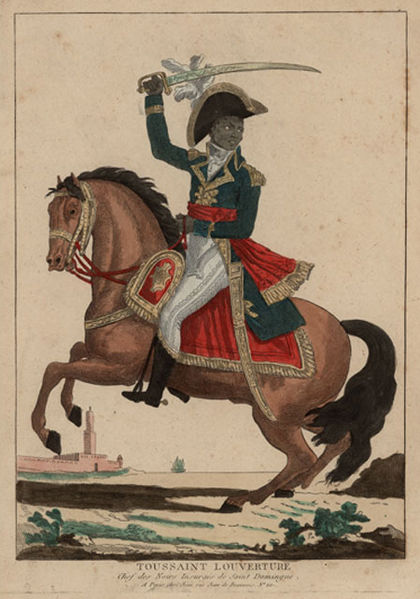
The Haitian Revolution was truly an inevitable occurrence after the Enlightenment. As the ideas of equality and freedom spread, it infiltrated all social classes, even slaves in Saint-Domingue. When L'Ouverture rose up in leadership, the large slave population realized how much power they had. The Haitian Revolution was a revolution with a very clear goal from start to finish: independence for the slaves.

Although L'Ouverture switched sides many times during the revolution, first leading the slaves, then siding with the Spanish, then back again with France, he had one goal in mind at all times. He first rose up against the white planters and free coloreds on the island with rebellions that threatened the precious economy of Saint-Domingue. He felt he needed to attack the group that was enslaving them, and therefore his enemy was the French. He soon decided to join the Spanish, having a common enemy in France. However, as soon as France saw they were close to losing a valuable island, the French National Assembly decided to approve the abolition of slavery. With their new freedom, the slaves decided to thank their benefactors (and protect their new freedom), France, by helping them remove the foreign invasion, including the English and the Spanish. They were very successful. However, when Napoleon came to power, their freedom was once again threatened. When the knowledge of L'Ouverture's constitution of 1799 reached Napoleon, it was seen as treason. Soon, L'Ouverture was losing his support among the slaves and France was sending ships to bring Saint-Domingue back under France's power. At that point, Napoleon was triumphant and L'Ouverture was taken prisoner and remained a prisoner for the rest of his life. However, his goal and motivation did not die with him. Under Dessalines' leadership, Saint-Domingue declared independence and the slaves' freedom on the island was protected by the law.

Saturday, November 13, 2010

Robespierre's take on terror


The most bloody time of the French Revolution was from 1793-1794, a period also known as Robespierre's "Reign of Terror." Robespierre was affiliated with the Mountain, the more liberal and radical part of the Jacobins (the other being the Girondists). From being an obscure lawyer to France's dictator, Robespierre was a strong leader with a clear direction for France and a mind set on achieving his goal, no matter the cost.

Robespierre's idea for France was a utopia achieved through a socialistic society. In his decree of August 2, 1793, he gave a specific job to each person in society, addressing young men, old men, women and even children. The soldiers were all well trained and were taught "Just cold steel, passion and patriotism," (McKay 700). Almost like communist China, the people were brainwashed with propaganda of patriotism and loyalty for their country. However, by 1794, France was victorious.

Robespierre also created a "planned economy," setting the maximum prices for goods and rationing bread so even the poor could eat. He tried to eliminate the luxuries of the wealthy and bring everyone to the same level, economically. He had a very communistic vision for France.

However, along with the pros, comes the cons. And the cons of Robespierre's plan were not pretty. Because he relied to heavily on the people's loyalty to France and their nationalism, he could not tolerate anyone who spoke or even thought against the way he was trying to run the society. He quieted all voices of opposition with the swing of the guillotine. His dictatorship was not called the "Reign of Terror," for nothing. Just like other communistic societies, the thought was nice, but in reality, it restricted freedom and was the farthest thing from the utopia he wanted. Ironically, in his speech to the National Convention in February of 1794, he says, "...that France...may eclipse the glory of all other free nations...That is our ambition: that is our aim." Maybe his eyes were set on the goal of freedom, but in his hand was the guillotine that snapped off the head of any independent thinker. He also said, "the basis of popular government in time of revolution is both virtue and terror: virtue without which terror is murderous, terror without which virtue is powerless." How does he mean this? Is it reasonable? Is it morally correct?

He means that with good provided by the society, must be the fear of doing anything to challenge the government, which runs the society. In his plan for society, the government was like a parent, equally distributing the good around to all the people, and keeping the people in the dark. In order for his plan to work, he needed the people to be frightened to challenge him and the government. It is true that a communist society can only work if the people are compliant and do not ask questions. But is a communist society the key to utopia?

I most certainly disagree with Robespierre. Socialism theoretically is a fine idea, but never works in real life. Instead, his plan limited the progress and freedom of the people. He was quick to kill any opposition, not only instilling fear throughout France, but becoming a bloody, merciless tyrant. He even executed his longtime corroborator Danton. The people feared they would be next, and rose up against him. Any good he accomplished was overshadowed by the terror that gripped the people. They took the power into their own hands during the next phase of the revolution, the Thermidorian period.

Thursday, October 21, 2010

The Whiskey Rebellion


http://www.ng.mil/resources/photo_gallery/heritage/images/lawsunion.jpg

The Whiskey Rebellion, like the Shays' Rebellion was about taxes, and what the people thought was unfair taxation. Shays' Rebellion was under the Articles of Confederation, while the Whiskey Rebellion of 1794 was under the new federal government. It was a test of the power and effectiveness of the new government.

Although he could have left the problem in the hands of Pennsylvania, George Washington decided to take matters into his own hand- and therefore involving the federal government. Marching to stop the rebellion with 15,000 militiamen, the rebellion was quickly ended. The federal government proved to be very effective.

The Shays' Rebellion was also put down by militiamen, but of the state, not the federal army. However, it was not nearly as effective as Washington's threat, which displayed the organization, power and involvement of the new government. Like Jefferson said,"I hold it, that a little rebellion, now and then, is a good thing." This proved true not only for Shays' Rebellion forcing the government to modify its current state, but also created a chance for the new federal government to prove itself. Is rebellion inevitable for a new and developing nation- even after many rebellions and new start?

Rebellions seem to be an effective way of bring attention to a cause, but there are other ways of making one's opinions understood by others without an uprising. However, those ways can only be taken advantage of if receipted well by a reasonable government. With Shays' Rebellion, there was no one to go to. With the Whiskey Rebellion, the government was still not ready to listen and had not made it easy for the people express their ideas in a way that would be accepted and taken into consideration. An uprising seemed to be the only option. Yet seeing how quickly the national government put down the rebellion, it showed the people that that practice was no longer effective or accepted. New ways of communication from the people to the government had to be made.

Wednesday, October 6, 2010

The Continental Congress: The Beginning of the End


The first Continental Congress marked the beginning of the end for the relationship of Britain and its colonies in America.

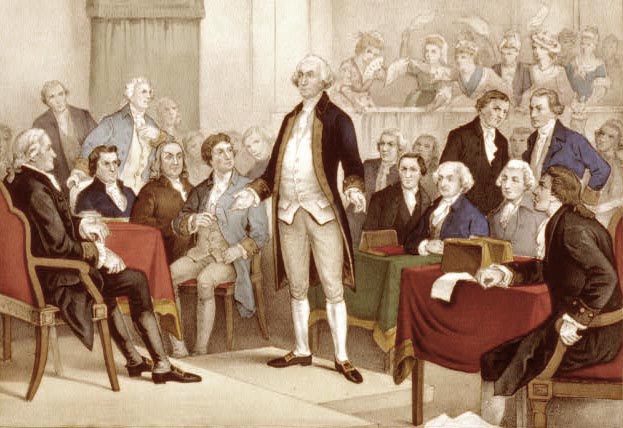
The friction between Britain and the colonies could be traced back to the French and Indian War, but it was not until the Continental Congress that the idea of independence was truly born. The colonies had already begun to rebel against Britain, creating groups like "the Sons of Liberty"and were actively showing public displays of their unwillingness to pay Britain's taxes. The Boston Massacre, the unfair taxes, like the Stamp Act, and the British soldiers stationed in the colonies fueled their anger enough to make them act out in violence against the loyalists. Boycotts became the way of life and even women became involved with the efforts. As Britain tried harder to gain control, the more the colonists became united as they faced an oppressor. All these factors led to the Continental Congress, showing the colonies finally taking control over themselves and making themselves a power to reckon with- wiping out all Britain's authority in America. This action leads almost directly to the War for Independence.

The Continental Congress made several important decisions for the colonies. The first was separating themselves from Britain's rule. Although they might still refer to the King, they would not be taxed. As much as it may appear they are still under the absolute power of the king, they were separating themselves from the British. No longer would Britain have the authority to tax the colonies as their own people. The suggestion screams for independence. They also wanted their own army of defense. But who do they have to fight against? The French were gone. The Native Americans were greatly weakened. They wanted the British soldiers out. They had no need for Britain's protection anymore. Why be under the British anymore? The Continental Congress also created and enforced boycotts until they got what they wanted. They agreed to meet in the spring again.
The problems were still far from being resolved. The men of the congress knew this and planned for another meeting in the spring. Just a year later, (1775) the war truly began with the "shots heard 'round the world."

The Continental Congress was the beginning of many meetings that would lead the America's independence- the end of Britain's control.

Picture:http://www.sonofthesouth.net/revolutionary-war/political/continental-congress.jpg

Wednesday, September 22, 2010

September 22: Scientific Revolution to Enlightenment-A very corrupt Church

In class, we discussed if the Scientific Revolution and the Enlightenment were two separate, distinguishable events in history, or if they were both parts of one movement. As we discussed, we came to the conclusion that the Scientific Revolution was part A, and the Enlightenment was part B of the whole. The Enlightenment was surely a result of the Scientific Revolution, but whether the period of Enlightenment was guaranteed to follow the Scientific Revolution was in question. Without certain factors, the Enlightenment would have not happened.

-The death of Louis XIV in France: released country from an absolute religious leader... softened religious orthodoxy
-Thinkers and philosophers were allowed to question all their beliefs, including religion: led to the (re)start of political theory... study of human behavior- asking larger questions that faced the everyday man/woman
-Science was popularized and made public: wealthy embraced the new ideas and encouraged further studies

There are many more, but all of these mentioned above have something to do with getting rid of the corrupt Church. The Church of the time was like an oppressive government, suppressing Europe with its viselike grip on the leaders and power of the people. The Church used religion as a way of restricting people to gain as much power as possible. They pretended to have power over the fate of lives, instilling fear and superstition in the hearts of the people. Fear that prevented change.

As the government's and Church's power started the slip away, the philosophes took advantage of the weakness and began to reform ways of thinking, allowing their true beliefs to surface. The resistance did not dissipate quickly at all, but the ideas had a chance to be made public, and although some work was made forbidden, and thinkers like Voltaire imprisoned, by the end of the Enlightenment, the Church (like the government) was left in shambles- much of its power gone.

People were working hard to purify things, finding truth, and the corrupt Church proved to be one of the biggest hindrances the scientists and thinkers of the Scientific Revolution and the Enlightenment encountered. It was during that time when Martin Luther made reforms to the Church itself. The Church had become more of a political power, versus a spiritual guide. It needed to change-for it did not represent true Christian beliefs. Even the pilgrims left Europe to the Americas in order to seek religious purity... without the persecution of the Church in power.

The Enlightenment went straight into the French Revolution, and the power of the old Church continued to dwindle as the current government was weakened and destroyed. The corrupt government had used the Church as an excuse for many things, and the Church had had a strong hold on the government. With the downfall of the corrupt government, and with the corrupt Church tumbling down after it, the political power was restored and society was able to advance.