Thursday, October 21, 2010

The Whiskey Rebellion


http://www.ng.mil/resources/photo_gallery/heritage/images/lawsunion.jpg

The Whiskey Rebellion, like the Shays' Rebellion was about taxes, and what the people thought was unfair taxation. Shays' Rebellion was under the Articles of Confederation, while the Whiskey Rebellion of 1794 was under the new federal government. It was a test of the power and effectiveness of the new government.

Although he could have left the problem in the hands of Pennsylvania, George Washington decided to take matters into his own hand- and therefore involving the federal government. Marching to stop the rebellion with 15,000 militiamen, the rebellion was quickly ended. The federal government proved to be very effective.

The Shays' Rebellion was also put down by militiamen, but of the state, not the federal army. However, it was not nearly as effective as Washington's threat, which displayed the organization, power and involvement of the new government. Like Jefferson said,"I hold it, that a little rebellion, now and then, is a good thing." This proved true not only for Shays' Rebellion forcing the government to modify its current state, but also created a chance for the new federal government to prove itself. Is rebellion inevitable for a new and developing nation- even after many rebellions and new start?

Rebellions seem to be an effective way of bring attention to a cause, but there are other ways of making one's opinions understood by others without an uprising. However, those ways can only be taken advantage of if receipted well by a reasonable government. With Shays' Rebellion, there was no one to go to. With the Whiskey Rebellion, the government was still not ready to listen and had not made it easy for the people express their ideas in a way that would be accepted and taken into consideration. An uprising seemed to be the only option. Yet seeing how quickly the national government put down the rebellion, it showed the people that that practice was no longer effective or accepted. New ways of communication from the people to the government had to be made.

Wednesday, October 6, 2010

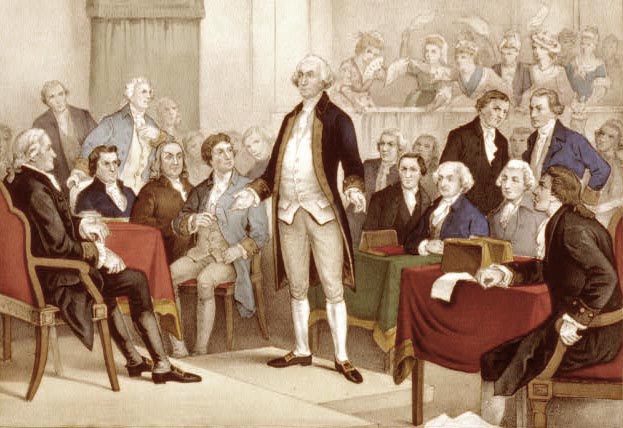
The Continental Congress: The Beginning of the End


The first Continental Congress marked the beginning of the end for the relationship of Britain and its colonies in America.

The friction between Britain and the colonies could be traced back to the French and Indian War, but it was not until the Continental Congress that the idea of independence was truly born. The colonies had already begun to rebel against Britain, creating groups like "the Sons of Liberty"and were actively showing public displays of their unwillingness to pay Britain's taxes. The Boston Massacre, the unfair taxes, like the Stamp Act, and the British soldiers stationed in the colonies fueled their anger enough to make them act out in violence against the loyalists. Boycotts became the way of life and even women became involved with the efforts. As Britain tried harder to gain control, the more the colonists became united as they faced an oppressor. All these factors led to the Continental Congress, showing the colonies finally taking control over themselves and making themselves a power to reckon with- wiping out all Britain's authority in America. This action leads almost directly to the War for Independence.

The Continental Congress made several important decisions for the colonies. The first was separating themselves from Britain's rule. Although they might still refer to the King, they would not be taxed. As much as it may appear they are still under the absolute power of the king, they were separating themselves from the British. No longer would Britain have the authority to tax the colonies as their own people. The suggestion screams for independence. They also wanted their own army of defense. But who do they have to fight against? The French were gone. The Native Americans were greatly weakened. They wanted the British soldiers out. They had no need for Britain's protection anymore. Why be under the British anymore? The Continental Congress also created and enforced boycotts until they got what they wanted. They agreed to meet in the spring again.
The problems were still far from being resolved. The men of the congress knew this and planned for another meeting in the spring. Just a year later, (1775) the war truly began with the "shots heard 'round the world."

The Continental Congress was the beginning of many meetings that would lead the America's independence- the end of Britain's control.

Picture:http://www.sonofthesouth.net/revolutionary-war/political/continental-congress.jpg

Wednesday, September 22, 2010

September 22: Scientific Revolution to Enlightenment-A very corrupt Church

In class, we discussed if the Scientific Revolution and the Enlightenment were two separate, distinguishable events in history, or if they were both parts of one movement. As we discussed, we came to the conclusion that the Scientific Revolution was part A, and the Enlightenment was part B of the whole. The Enlightenment was surely a result of the Scientific Revolution, but whether the period of Enlightenment was guaranteed to follow the Scientific Revolution was in question. Without certain factors, the Enlightenment would have not happened.

-The death of Louis XIV in France: released country from an absolute religious leader... softened religious orthodoxy
-Thinkers and philosophers were allowed to question all their beliefs, including religion: led to the (re)start of political theory... study of human behavior- asking larger questions that faced the everyday man/woman
-Science was popularized and made public: wealthy embraced the new ideas and encouraged further studies

There are many more, but all of these mentioned above have something to do with getting rid of the corrupt Church. The Church of the time was like an oppressive government, suppressing Europe with its viselike grip on the leaders and power of the people. The Church used religion as a way of restricting people to gain as much power as possible. They pretended to have power over the fate of lives, instilling fear and superstition in the hearts of the people. Fear that prevented change.

As the government's and Church's power started the slip away, the philosophes took advantage of the weakness and began to reform ways of thinking, allowing their true beliefs to surface. The resistance did not dissipate quickly at all, but the ideas had a chance to be made public, and although some work was made forbidden, and thinkers like Voltaire imprisoned, by the end of the Enlightenment, the Church (like the government) was left in shambles- much of its power gone.

People were working hard to purify things, finding truth, and the corrupt Church proved to be one of the biggest hindrances the scientists and thinkers of the Scientific Revolution and the Enlightenment encountered. It was during that time when Martin Luther made reforms to the Church itself. The Church had become more of a political power, versus a spiritual guide. It needed to change-for it did not represent true Christian beliefs. Even the pilgrims left Europe to the Americas in order to seek religious purity... without the persecution of the Church in power.

The Enlightenment went straight into the French Revolution, and the power of the old Church continued to dwindle as the current government was weakened and destroyed. The corrupt government had used the Church as an excuse for many things, and the Church had had a strong hold on the government. With the downfall of the corrupt government, and with the corrupt Church tumbling down after it, the political power was restored and society was able to advance.